
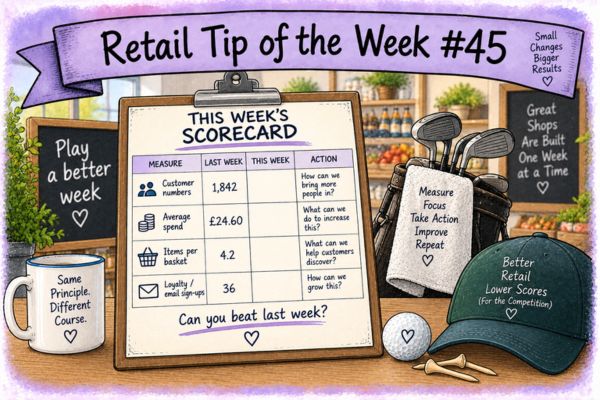
The Retail Scorecard: Three Numbers That Can Help You Improve Your Shop
One of the things I like about golf is the honesty of the scorecard.
You can feel like you're playing brilliantly.
You might hit a few fantastic shots.
But eventually you have to write the number down.
And the scorecard tells you whether you're actually getting better.
I think there's a really useful lesson in there for independent retailers.
Are you busy — or are you improving?
It's very easy to confuse the two.
Your shop can be busy. Your team can be working incredibly hard and your counters can look fantastic.
But is the business actually improving?
That's where having a few simple numbers can really help.
I'm not talking about creating an enormous spreadsheet containing dozens of measures that nobody looks at.
Start with three.
1. Customer numbers
How many customers actually bought something from you last week?
It's one of the simplest numbers you can measure.
Then don't just record it.
Ask:
What could we do this week to bring more people through the door?
Could you send a customer email?
Create a stronger social media post?
Give customers a reason to visit with a tasting, new product, seasonal display or special event?
The number tells you what happened.
The action is what might change it.
2. Average spend
Next, look at how much the average customer spends with you.
Again, don't just write the number down and hope it increases.
Ask what you could actually do on the shop floor to influence it.
Perhaps there's a brilliant product that customers aren't discovering.
Put it on to sample.
Make sure the team taste it too. Give them two or three useful things to tell customers about it and perhaps something they can naturally recommend alongside it.
You don't need every member of the team trying to sell everything.
Get them focused on one thing.
Then see what happens to the score.
3. Items per basket
How many individual products does the average customer buy?
This is another number where relatively small changes can make a big difference over hundreds or thousands of transactions.
Look at the products that naturally belong together.
Steak and peppercorn sauce.
Cheese and chutney.
Strawberries and cream.
Sausages and mash.
Are you making those connections obvious to your customers?
Sometimes increasing the basket isn't about “selling more”.
It's about making it easier for the customer to buy the whole meal.
Put an action beside every number
This, for me, is the important part.
A scorecard that simply records numbers is interesting.
A scorecard that changes what you do is useful.
So keep yours really simple:
Customer numbers → What will we do to bring more people in?
Average spend → What will we do to increase it?
Items per basket → What will we help customers discover?
Choose one practical action against each.
Then give it a week.
Get your team involved
I'd put the scorecard somewhere your team can see it.
Not as pressure.
Not as a league table.
And certainly not as another stick to beat people with.
Use it to show them how the small things they do every day contribute to the bigger picture.
Giving out samples.
Talking confidently about a product.
Suggesting an accompaniment.
Signing someone up to your customer email.
Creating a better display.
None of those things feels enormous on its own.
But repeat them hundreds of times and the scorecard starts to move.
Once you've got into the habit, you might decide to measure other things.
Email sign-ups.
Loyalty card registrations.
Sampling.
Repeat visits, if your systems allow you to track them.
But don't start by measuring everything.
Start with three.
Can you beat last week?
Next week, put the new numbers alongside the old ones.
What moved?
What didn't?
What action worked?
What could you try differently?
You're not necessarily looking for a record-breaking week every week. Retail doesn't work like that.
What you're trying to create is a habit of measuring, taking action, learning and improving.
Which brings me back to golf.
You don't become a better golfer by standing in the clubhouse staring at your scorecard.
You change something about the way you play.
And it's exactly the same in retail.
You don't improve your score by staring at the scorecard.
You improve it by changing what you do before you hand the card in.
