
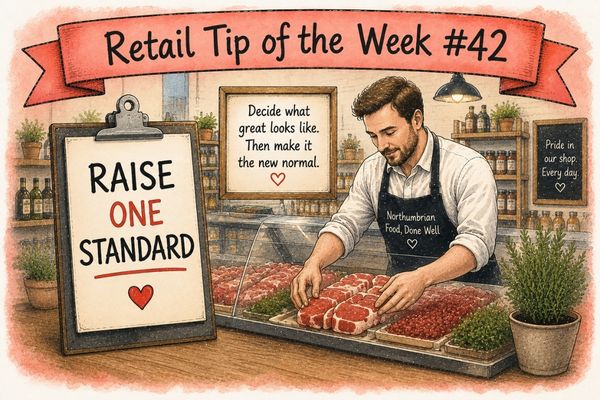
Raise One Standard: How Great Retailers Make 10/10 the New Normal
Raise One Standard: How Great Independent Retailers Make 10/10 the New Normal
One of the biggest lessons I took from a recent visit to Disney wasn't about rides, characters or entertainment.
It was about standards.
Disney doesn't create an exceptional experience through one enormous thing.
It's hundreds of little things.
Done well.
Again and again.
And while none of us are trying to turn our butcher's shop, farm shop or food hall into Disney, I think there's a really useful retail lesson in there.
Great standards don't happen by accident.
They're defined.
They're demonstrated.
And then they're maintained.
Where are you accepting 7/10?
Every independent retail business has areas that aren't bad...
They're just not brilliant.
The entrance might be tidy, but not immaculate.
Your counter might look fantastic first thing in the morning, but considerably less impressive by mid-afternoon.
Your team might be friendly, but the customer greeting varies depending on who's working.
Your displays might be good, but there's one you've walked past for months knowing it could be better.
None of these things are necessarily causing complaints.
That's what makes them so easy to accept.
They're 7/10.
And 7/10 can be dangerous because it's good enough not to demand attention.
Pick one standard
Here's an exercise I'd encourage you to try.
Don't walk into work tomorrow and announce that standards need improving across the business.
That's far too vague.
Instead, choose one thing.
Perhaps it's your butchery counter.
Your entrance display.
The way your team answer the telephone.
Your staff uniform.
Your toilets.
Your product labelling.
Your packaging.
The way the shop looks during the final two hours of trading.
Pick something that's currently a 7/10 and ask:
“What would 10/10 actually look like?”
That's where this exercise becomes useful.
Define what great looks like
We use phrases like “keep the counter looking good” all the time.
But what does “good” mean?
One team member's idea of good might be very different from another's.
So get specific.
If you're working on your butchery counter, 10/10 might mean every tray is faced forward, there are no obvious gaps, tickets are perfectly straight, glass is spotless and the counter still looks abundant at 4pm.
If it's your entrance, perhaps 10/10 means clean glass, an immaculate mat, full baskets, no empty cardboard boxes and one strong seasonal display immediately giving customers a reason to explore.
If it's customer service, don't simply tell the team to “be friendlier”.
What does great actually sound like?
How quickly should a customer be acknowledged?
What happens when someone is waiting?
What language do you want the team to use?
What should never happen?
The clearer you make the standard, the easier it becomes for everybody to deliver it.
Show your team
Once you've achieved 10/10, capture it.
Take a photograph if it's something visual.
Show the team.
Say:
“This is what great looks like.”
Now you've removed the ambiguity.
You're no longer asking people to interpret what you mean by a “great display” or a “really good counter”.
They can see it.
And that makes maintaining the standard considerably easier.
Then comes the difficult bit
Getting something to 10/10 once isn't the real challenge.
Keeping it there is.
Anyone can create a beautiful display when they know someone important is visiting.
Anyone can make the shop immaculate for an awards judge.
Anyone can deliver exceptional service while the boss is standing beside them.
The real standard of your business is what happens on an ordinary Tuesday afternoon when nobody is watching.
That's where consistency matters.
And that's one of the things businesses like Disney understand so well.
The details aren't reserved for special occasions.
They're simply how things are done.
Make 10/10 the new normal
Once that first improvement becomes routine, choose another.
Not twenty.
One.
Find another 7/10.
Define 10/10.
Get it there.
Make it normal.
Then repeat.
Over a year, imagine what happens if you genuinely raise one standard at a time and refuse to let each one slip backwards.
Your business starts to change.
Not through one enormous transformation.
But through dozens of small improvements that gradually become simply “the way we do things here.”
That's how standards become culture.
And that's the real lesson.
You don't create an exceptional retail business by occasionally doing something exceptional.
You create it by deciding what great looks like — and then making great the new normal.
