
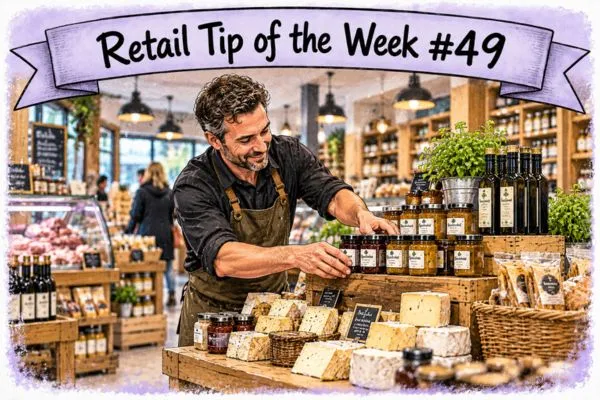
Move It, Don't Just Look at It: How Better Product Positioning Can Increase Sales
Here's a question worth asking yourself the next time you walk around your shop.
How many products are sitting exactly where they've always been?
Not because that's necessarily the best place for them, but simply because nobody has ever thought about moving them.
We all do it.
A product goes onto a shelf, into a display or behind the counter, and that's where it stays. Customers get used to finding it there, the team knows where it lives, and eventually we stop questioning whether it could be selling better somewhere else.
But what if a simple change of position could make a difference?
Sometimes the product isn't the problem
Think about a brilliant local chutney sitting on a shelf towards the back of your shop.
It's a good product. Customers who buy it love it, and it sells reasonably well. But unless someone goes looking for chutney, there's a fair chance they'll walk straight past it.
Now imagine moving a few jars alongside your bestselling cheese.
Suddenly, you're not relying on customers remembering they need chutney. You're putting it right in front of them at the moment they're choosing something it goes perfectly with.
Same product. Same price. Different position.
And potentially, a completely different result.
The same thinking applies across almost every department in an independent food shop.
A particular Sausage might sell better in a more prominent position on your Butchery Counter. A locally produced Sauce could perform better alongside the Steaks. Or perhaps those lovely Biscuits you've been struggling to shift would get more attention next to the Coffee.
None of these changes requires a new product, an advertising campaign or a big investment.
Just a willingness to try something different.
Stop looking at your displays and start experimenting
One of the dangers of running a shop is that we become so familiar with our surroundings that we stop really seeing them.
We walk past the same shelves and displays every day. We know where everything is, and because it all looks reasonably tidy, we assume it's working.
But looking good and selling well aren't necessarily the same thing.
A display shouldn't just fill a space. It should help sell the products on it.
So rather than spending hours planning a complete shop rearrangement, why not start with one product?
Choose something you genuinely believe deserves to sell more.
It could be a product with a good margin, something customers rave about once they've tried it, or simply an item that's been overlooked because of where it's positioned.
Then ask yourself where it might perform better.
Could it be more visible? Could it sit alongside a complementary product? Would it benefit from being closer to the counter, or somewhere customers naturally stop and browse?
And then comes the important part.
Move it.
Give it seven days
Here's a simple exercise you can try in your own shop this week.
Choose one product and find out how many you sold over the previous seven days. Then move it to a different position, keeping the price and any promotions the same if possible.
Leave it there for a week and see what happens.
Don't overcomplicate it.
You're simply trying to discover whether a change in position can help you sell more of something you're already stocking.
If sales increase, brilliant. You've learned something useful, and you've got a good reason to keep that product in its new position.
If they don't, you've still learned something.
Perhaps the new position wasn't right. Maybe the product needs a better explanation, or perhaps it simply isn't as popular as you thought.
Try another position, another product or a different combination.
Just remember that one week's results won't tell you everything. Weather, customer numbers and seasonal demand can all influence sales, so compare similar trading periods where possible.
The important thing is to start testing rather than assuming.
Think about how customers actually shop
Good merchandising isn't just about putting your best products in the most prominent positions.
It's about making buying easier.
Think about the products your customers naturally use together. Cheese and Chutney. Steak and Peppercorn Sauce. Pasta and Pesto. Coffee and Biscuits.
When those products are displayed together, you're helping customers make a decision they might not otherwise have made.
And sometimes it's not even about selling an additional product.
I
