
How to Increase Your Average Transaction Value: The Bigger Basket Checklist
How easy are you making it for customers to spend a little more in your shop?
It's a question I think every independent retailer should ask themselves regularly. Because while we're all looking for ways to attract more customers, there's another opportunity that can sometimes get overlooked.
Helping the customers we've already got discover one more thing they'd love to buy.
I'm not talking about putting prices up or pressuring people into buying products they don't want. I'm talking about making sure our shops, our displays, our product ranges and our teams are doing everything they can to help customers find what they need.
And sometimes, the smallest improvements can make a surprisingly big difference.
Why your Average Transaction Value matters
Your Average Transaction Value, or ATV, is simply the average amount a customer spends each time they shop with you.
You calculate it by dividing your total sales by the number of transactions.
For example, if your shop takes £10,000 from 500 transactions, your ATV is £20.
Now imagine increasing that average spend by just 50p.
With the same 500 transactions, that's an additional £250 in sales. Not from attracting more customers, but from making a little more of the opportunities you already have.
Of course, additional sales aren't the same as additional profit, and you still need to consider the margins on the products you're selling.
But it's worth paying attention to.
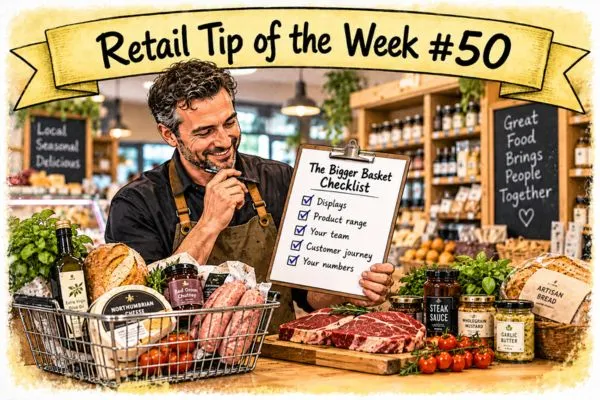
The Bigger Basket Checklist
Here's a practical exercise you can do in your own shop.
Set aside 15 minutes, grab a notebook and walk around your business. Look at the following five areas and ask yourself where you could make it easier for customers to buy a little more.
You don't need to make enormous changes. In fact, I'd encourage you to start small.
1. Your displays: Are you helping customers discover more?
Walk around your shop as though you're visiting for the first time.
What catches your eye? Which products are easy to notice, and which are tucked away where customers might never see them?
Think about whether you're displaying products that naturally belong together.
Could your bestselling Cheese be displayed alongside a lovely local Chutney? Would a customer buying Steak appreciate seeing a Peppercorn Sauce nearby? Are your Coffee and Biscuits close enough to encourage someone to pick up both?
Good merchandising doesn't just make your shop look attractive. It helps customers make buying decisions.
Look for one display where a simple change could encourage an additional purchase.
2. Your product range: Have you got the right things to add to a basket?
Sometimes the opportunity isn't about moving products around.
It's about what you're stocking in the first place.
Have you got a good selection of smaller, affordable products that customers can easily add to their shopping? Are there gaps in your range where something would naturally complement what customers already buy?
For example, someone buying a joint of Beef might be interested in a good Horseradish Sauce. A customer picking up a fresh loaf of Bread might be tempted by a locally made Jam.
But only if you've got the products available.
It's also worth thinking about pack sizes and price points. Not everyone wants a large pack or an expensive addition to their shopping, so smaller options can sometimes make that extra purchase easier.
Ask yourself: What are customers buying from us that we could help them enjoy even more?
3. Your team: Are they confident making recommendations?
This is a big one.
You can have the best products in the world, but if your team doesn't know what makes them special, you're missing an opportunity.
Do they know which products work well together? Have they tasted the products they're recommending? Could they confidently explain why a customer might enjoy something?
Think about the difference between simply serving someone four Pork Chops and saying:
"Have you tried our Apple Sauce with those? It's lovely."
It's a small suggestion, but it could make the customer's meal better while introducing them to something new.
And that's the important distinction.
Good selling should feel like good customer service.
Spend a few minutes with your team identifying products they could naturally recommend alongside popular purchases. Make sure they've got the knowledge and confidence to do it without sounding pushy.
4. Your customer journey: Are you missing opportunities along the way?
Now think about how customers move around your shop.
What do they see when they first walk through the door? Where do they naturally stop? What catches their attention as they approach the counter or checkout?
Every part of that journey creates an opportunity to introduce customers to something they might otherwise have missed.
Perhaps there's room for a small seasonal display near the entrance. Maybe a carefully chosen product beside the till would make a useful last-minute purchase, or perhaps a product that's currently hidden away deserves a more prominent position.
But don't fall into the trap of filling every available space with more stock.
A comfortable, easy-to-shop environment matters too.
The aim isn't to make customers buy more. It's to make it easier for them to find more of what they want.
5. Your numbers: Do you know whether any of this is working?
Finally, let's talk about the numbers.
Do you know your current Average Transaction Value?
Do you know how many items customers typically buy per transaction?
And can you see whether those numbers are improving?
ATV tells you how much customers spend on average, while items per basket helps you understand whether they're actually buying more products. Looking at both can be useful, particularly when prices are changing.
You don't need a complicated reporting system to get started.
Find out where you are today, make a change and compare your results over a sensible period. Where possible, look at similar trading days and check whether the additional sales are delivering worthwhile gross profit.
Because there's little point making changes if you never find out whether they've worked.
Don't try to fix everything at once
By the time you've worked through those five areas, you'll probably have a few ideas.
You might have spotted a display that could work harder, a gap in your product range or an opportunity to improve your team's product knowledge.
Brilliant.
But here's where I'd encourage you to be disciplined.
Pick just ONE thing.
Choose the improvement you think has the best chance of making a difference. Put it into action this week, then give it enough time to see whether it's working.
You can always come back to the checklist and tackle something else later.
Small improvements can make a big difference
One of the things I've learned from running a retail business is that we can spend an awful lot of time thinking about how to attract more customers through the door.
And of course, that's important.
But sometimes we're overlooking the opportunities that are already sitting right in front of us.
A better display. A more thoughtful product range. A team member who knows exactly what to recommend.
None of these things needs to cost a fortune, but each could help a customer discover something they wouldn't otherwise have bought.
So here's my challenge.
Take 15 minutes, walk around your shop with the Bigger Basket Checklist and identify one thing you could do better.
Then do it.
Because increasing your sales isn't always about finding more customers.
Sometimes it's about looking after the customers you've already got, and making it easier for them to put one more thing in their basket.
