
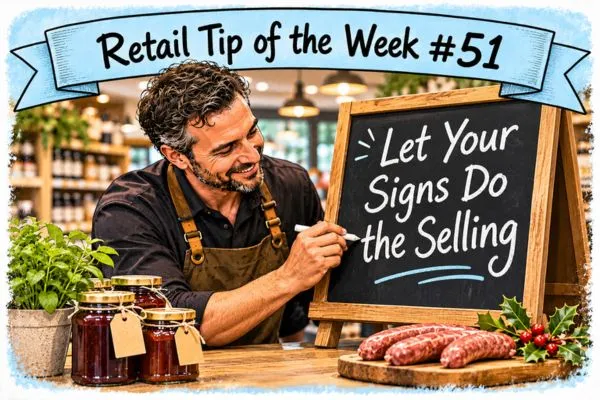
Let Your Signs Do the Selling: How Better In-Store Signage Can Increase Sales
Let Your Signs Do the Selling: How Better In-Store Signage Can Increase Sales
As we head towards Christmas, our shops are going to get busier, our teams are going to be stretched, and we're going to have less time to talk to every customer who walks through the door.
But here's something worth thinking about.
What if your signs could do some of the selling for you?
We spend a lot of time thinking about our displays, our product ranges and how we can improve customer service. Yet one of the simplest selling tools in our shops is often overlooked.
Our in-store signage.
And I'm not just talking about making sure everything has a price on it.
I'm talking about signs that actually give customers a reason to buy.
A lesson I learnt at Zingerman's Delicatessen
Many years ago, I visited Zingerman's Delicatessen in Ann Arbor, Michigan, and one of the things that really struck me was how brilliantly they used their in-store signage.
They call them talkies.
They're little signs that do exactly what the name suggests. They talk to customers, sharing something interesting about a product, explaining what makes it special or simply giving someone a reason to try it.
And Zingerman's are brilliant at it.
It's something I've tried to bring into our own business over the years, although I'll be the first to admit we could still do it better. In fact, whenever I visit other independent food shops, I'm often reminded just how much opportunity there is for all of us to improve the way we communicate with customers.
Because too often, all we give them is a product name and a price.
That's a label. Not a salesperson.
What's the difference between a label and a talkie?
A label tells customers what something is.
A talkie tells them why they might want to buy it.
It's a small distinction, but an important one.
Think about a customer browsing your shelves. They might be interested in a product, but they're not quite sure what to do with it, what makes it special or why they should choose it over something else.
A good talkie can answer that question without a member of your team having to say a word.
And as Christmas approaches, that's particularly valuable.
When your shop is busy and your team is serving customers, those little signs can carry on selling in the background.
But what should they actually say?
Three ways to make your signs work harder
There isn't one perfect formula for writing a talkie.
Different products need different approaches, and sometimes the simplest message is the most effective.
Here are three examples to get you thinking.
1. Give customers a reason to use it
Imagine a jar of Christmas Chutney sitting on your shelves.
You could simply have a label saying Christmas Chutney and the price.
Or you could add:
"Perfect with Your Christmas Cheeseboard!"
That's it.
Just a few words, but now you've helped the customer imagine when and how they might enjoy the product.
Perhaps they weren't planning to buy Chutney, but they've already got Cheese on their Christmas shopping list.
Suddenly, you've given them a reason to put another product in their basket.
2. Tell customers what makes it special
Now imagine some homemade Shortbread sitting on your Bakery counter.
You could simply label it Shortbread.
Or you could say:
"Handmade in Our Bakery, in Small Batches Every Morning."
Now you're communicating something customers might not otherwise know.
You're telling them about the care, freshness and craftsmanship behind the product. You're giving them a reason to choose your Shortbread rather than a mass-produced alternative.
And that's important.
Never assume your customers know what makes your products special.
Just because you and your team know something is made in-house, locally sourced or produced using a traditional method doesn't mean your customers know it too.
Sometimes you have to tell them.
3. Give your product some personality
Let's take a homemade Pork & Ale Sausage made using beer from a local Northumbrian brewery.
You could simply describe it as Pork & Ale Sausage.
But what about:
"Made with Northumbrian Ale. By Butchers Who Know Their Sausages."
Now you've got something a little more interesting.
You're combining a distinctive ingredient, local provenance and the skill of the people making the product.
It's giving customers something to remember, something to talk about and hopefully a reason to try it.
Of course, these are just examples. Any claims about ingredients, provenance or production methods need to be accurate.
But the principle is the same.
Find what makes the product worth buying, then communicate it in as few words as possible.
Don't confuse more words with better selling
One of the mistakes we can make with signage is trying to tell customers absolutely everything.
Where a product comes from, how it's made, who makes it, what ingredients it contains, what awards it's won and why it's wonderful.
Before you know it, you've written an essay.
And the customer has walked past.
A good talkie needs to be easy to read, particularly when someone is browsing a busy shop.
So rather than trying to include every selling point, ask yourself one question.
What's the single most compelling thing I could say about this product?
Perhaps it's an unusual ingredient. Maybe it's a serving suggestion, a family recipe, a Great Taste award or a story about the local producer.
Choose the message that's most likely to make your customer stop and take notice.
And remember, a clever phrase isn't enough on its own. Your message needs to be believable, relevant and genuinely useful.
Where should you put your talkies?
Writing a brilliant sign is only half the job.
Customers need to see it.
A small talkie placed directly beside the product can often be more useful than a large poster on the other side of the shop.
Think about the places where customers naturally stop and browse. Your Butchery Counter, Bakery display, Cheese section, Christmas gifting area or shelves of local products.
Are there products in those areas that would benefit from a few carefully chosen words?
Make sure your signs are readable, that the price is clear and that they don't make your displays look cluttered.
You want to catch customers' attention, not overwhelm them.
And perhaps most importantly, keep them fresh.
A sign that has been sitting in the same place for months can become just another part of the background.
The five-talkie challenge
Here's something practical you can do in your own shop this week.
Choose FIVE products you'd love to sell more of this Christmas.
They might be products with a great story, something handmade in your own business, a brilliant local product or simply something customers often overlook.
For each product, ask yourself:
What's special about it?
Why would a customer want it?
What's the one thing I could say that would make someone stop and take notice?
Then write a short talkie for each one.
Don't spend hours trying to find the perfect words. Start with a simple message, put the sign beside the product and see what happens.
Do customers stop and read it? Do they pick up the product? Does it start a conversation?
And most importantly, does it help you sell more?
If possible, compare sales before and after introducing your new signage. You might discover that a few carefully chosen words make a bigger difference than you expected.
And if something doesn't work, try a different message.
That's how you learn what appeals to your customers.
Your signs are part of your selling team
As independent retailers, one of our greatest strengths is the knowledge and passion of the people working in our businesses.
We know our products. We know the producers, the ingredients and the stories behind them.
But when we're busy, we can't share that knowledge with every single customer.
That's where good signage comes in.
Your talkies give your products a voice, even when your team is busy serving someone else.
And with Christmas approaching, there's probably no better time to start making them work harder.
So take a walk around your shop this week.
Look at the products that deserve more attention, think about what makes them special and find the few words that could help sell them.
Five products. Five talkies. Five more opportunities to make a sale.
Because sometimes, the difference between a customer walking past a product and putting it in their basket is simply knowing why they should buy it.
